EB-2 NIW Approval Rate 2026: Latest USCIS Data & What It Means For You


The EB-2 NIW (National Interest Waiver) Green Card approval rate for 2025 was 55.2%, and in quarter four it dropped to a historic low of 35.7%, marking the first quarter on record where USCIS denied more petitions than it approved. These numbers represent a fundamental shift in what it takes to secure approval. Unlike other employment-based categories, the NIW allows applicants to self-petition without employer sponsorship or labor certification, making it a highly desirable pathway for skilled professionals in STEM and non-STEM fields alike.
According to USCIS Form I-140 data, the NIW approval rate has declined every year since 2022 where it was 95.7%. Within the last year, the picture was highly volatile: rates recovered to 62.8% in Q1 and 67.3% in Q2 before collapsing to 54.0% in Q3 and 35.7% in Q4. While securing an NIW remains possible for well-prepared applicants, these numbers highlight a fundamentally tighter adjudication environment.
But what’s driving these changes? And more importantly, what can applicants do to increase their chances of success?
In this article, we’ll break down:
✔ The latest EB-2 NIW approval and denial rates (FY2025 full-year and quarterly breakdown)
✔ The Matter of Dhanasar three-prong test, the legal standard USCIS uses to adjudicate every NIW petition
✔ How STEM and non-STEM professionals are affected
✔ Processing times, premium processing fees, and priority date backlogs
✔ Common reasons for denials and RFEs
✔ Strategies to strengthen your EB-2 NIW petition
Learning about these trends, based on data from USCIS reports on STEM-Related Petition Trends and the Form I-140 Immigrant Petition for Alien Worker by Fiscal Year, Quarter, and Case Status, will help applicants navigate the process more effectively and avoid common pitfalls that lead to delays or rejections.
Let’s begin by breaking down the latest EB-2 NIW approval rates and analyzing how they have changed over the years.
Breaking down the EB-2 NIW approval rate, trends & key insights
Understanding how the EB-2 NIW approval rate has changed over time provides valuable insight into the visa’s current landscape. The trend over the past four fiscal years shows a consistent and steep decline, raising important questions about why approvals have fallen and what applicants can do to strengthen their cases.
How the EB-2 NIW approval rate has changed
The EB-2 NIW approval rate has declined sharply over the past four fiscal years, reflecting shifts in USCIS processing trends, applicant volume, and adjudication standards:
- FY2025: 55.2%, A steep decline driven by a historic low of 35.7% in Q4, the first quarter where USCIS denied more petitions than it approved.
- FY2024: ~71%, A significant drop from FY2023’s ~80%, as USCIS began applying the Dhanasar standard more rigorously and application volume surged.
- FY2023: ~80%, A decline from FY2022 but still relatively high; NIW petition receipts nearly doubled this year, from ~21,990 in FY2022 to ~39,810.
- FY2022: 95.7%, A historically strong year, partly reflecting USCIS backlog clearance following updated NIW guidance issued after Biden’s Executive Order 14012.
This downward trend from 95.7% in 2022 to 55.2% in 2025 suggests that USCIS has tightened its review process, making it more critical than ever for applicants to submit well-documented petitions.
A closer look at 2025’s quarterly breakdown reveals just how volatile the adjudication environment has become:
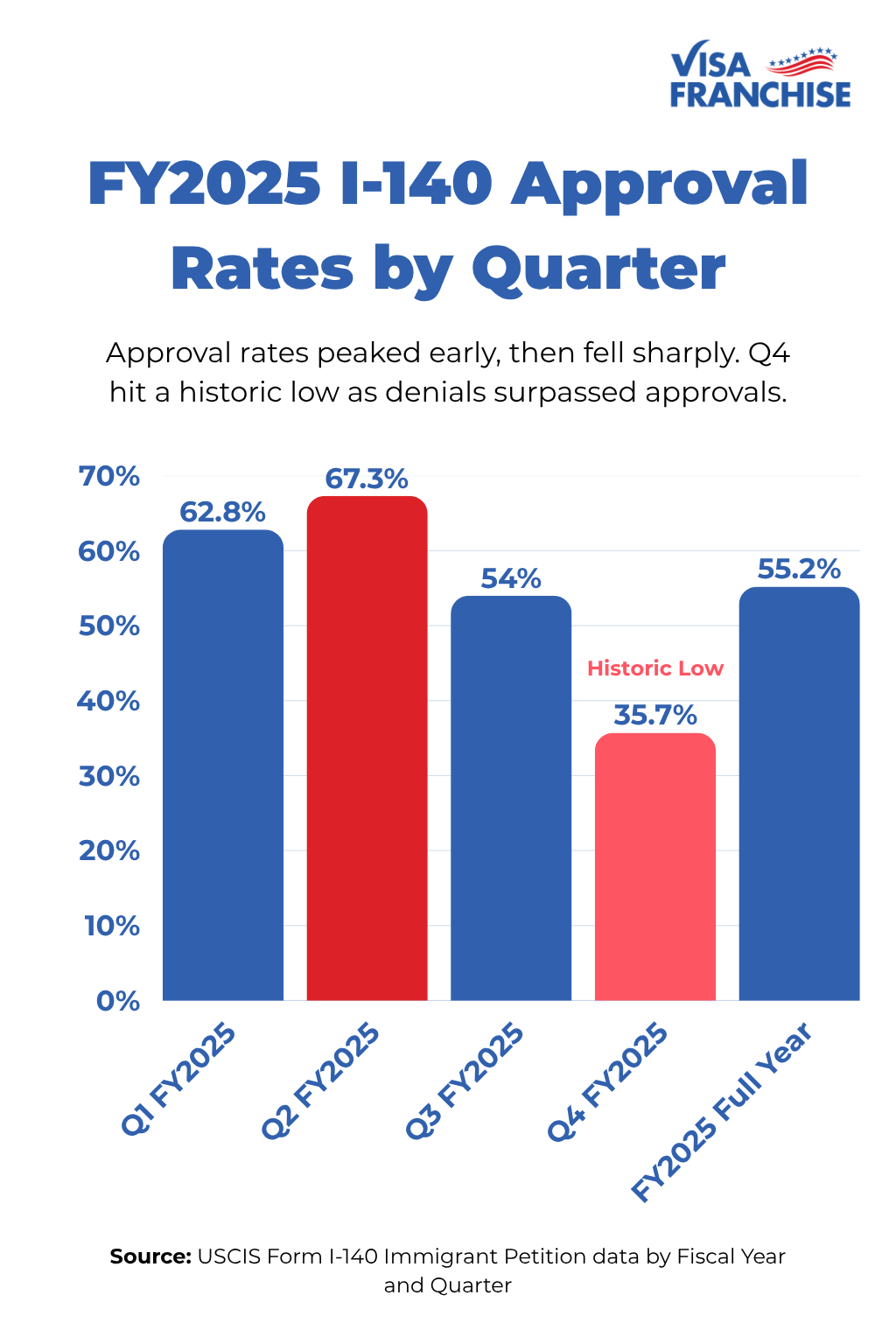
Early 2026 data from Lawfully, a third-party case tracking platform, shows regular processing approval rates recovering to approximately 44% as of March 2026, up from a low of around 26% in September 2025. Official USCIS data for 2026 Q1 has not yet been published as of April 2026.
What’s behind the decline in EB-2 NIW approvals?
Several factors have contributed to the recent decline in the EB-2 NIW success rate:
✔ Stricter USCIS Scrutiny: Officers are closely evaluating whether an applicant’s work truly serves the national interest, leading to more Requests for Evidence (RFEs) and denials.
✔ Surge in Application Volume: USCIS received approximately 63,549 EB-2 NIW petitions in 2024, nearly triple the amount filled in 2022. Higher volume has translated directly into more rigorous screening.
✔ More RFEs (Requests for Evidence): USCIS is demanding additional documentation to justify approvals, making it crucial for applicants to provide clear, compelling evidence of their qualifications.
✔ Priority Given to STEM Fields: While STEM professionals continue to have comparatively higher approval rates, non-STEM applicants face greater scrutiny.
What Is the Matter of Dhanasar? The 3-Prong test explained
Every EB-2 NIW petition is evaluated against the three-prong framework established in Matter of Dhanasar. Understanding these prongs is the single most important thing an applicant can do to prepare a strong petition, and failing to address any one of them clearly is the most common reason USCIS issues an RFE.
Immigration attorneys consistently flag Prong 3 as being overlooked. A strong petition should answer the following: why can’t this work wait for a PERM? Why does it require your physical presence in the United States? Why can’t USCIS simply recruit someone with equivalent training? One’s application gains strength when your answers are more specific and backed by evidence.
Submitting a strong and well-documented EB-2 NIW petition is increasingly more important because of the declining approval rate and the increase of RFEs. The most effective strategies map directly to the three Dhanasar prongs.
EB-2 NIW approval rates for STEM vs. Non-STEM professionals
While the overall EB-2 NIW approval rate has declined, a closer look at the data reveals a clear distinction between STEM and non-STEM professionals. Over the years, STEM applicants have consistently seen higher success rates, while those in non-STEM fields have faced more challenges in securing approval.
Higher approval rates for STEM professionals
For professionals in science, technology, engineering, and mathematics (STEM) fields, EB-2 NIW approval rates were historically very strong. In 2021, STEM applicants saw an approval rate of 93%, which increased to 95% in 2022. Even in 2023, despite broader tightening across categories, STEM approvals remained high at 91%, significantly outperforming overall averages.
However, the adjudication environment shifted sharply in 2024 as overall approval rates declined to approximately 71%, reflecting increased scrutiny across the board and the first full-year effects of the surging application volume. By 2025, STEM applicants began feeling the effects of stricter standards, however they continue to perform comparatively better than non-STEM professionals.
One of the main reasons STEM applicants maintain an advantage is the U.S. government’s continued emphasis on attracting talent in critical, STEM-focused industries. Software engineers, biomedical researchers, AI specialists, and data scientists often have clearer pathways to demonstrating national importance, measurable impact, and alignment with strategic economic priorities.
Another important consideration for STEM applicants is the priority date, which determines eligibility to file Form I-485 for an adjustment of status. As demand rises and backlogs increase, understanding visa bulletin movement and processing timelines has more importance because timing is essential to avoid delays.
Why Non-STEM professionals face greater challenges
While STEM professionals have maintained strong approval rates, non-STEM applicants have experienced more fluctuations. In 2021, the approval rate for non-STEM professionals was 71%, increasing to 81% in 2022. However, by 2023, the approval rate dropped to just 66%, signaling a stricter review process and a shift in USCIS’s priorities.
For non-STEM applicants, the challenge lies in proving that their work has substantial merit and national importance, Prong 1 of the Dhanasar test. USCIS often scrutinizes applications from business professionals, educators, artists, and other non-technical fields more closely, making it critical to:
✔ Present clear evidence of how their work benefits the U.S. economy, innovation, or workforce development.
✔ Demonstrate extraordinary ability or national impact, similar to what is required for EB-1A applicants.
✔ Submit strong letters of recommendation from industry experts to reinforce their qualifications.
While non-STEM professionals qualify for the EB-2 NIW, they must be more strategic and proactive in building a compelling case.
Key takeaways for applicants in 2026
- STEM professionals continue to maintain a comparative advantage.
- Non-STEM professionals qualify but build a strong case to prove national interest.
- Understanding priority dates and backlogs is essential.
- A well-structured petition with strong documentation is critical for success, regardless of field.
Success Story
A Cameroonian entrepreneur demonstrated how he leveraged both his STEM and non-STEM background to obtain the EB-2 NIW Green Card. He utilized his experience in the oil and gas industry, engineering, and real-estate to secure approval for an E-2 NIW Green Card.
By bridging multiple aspects of his career, he presented evidence to USCIS showing his impact on a critical industry and his work’s broader level economic contributions. Explore his story deeper along with the 20 in-depth success stories found in our founding partner, Patrick Findaro’s, latest book: Own Your American Dream.
EB-2 NIW processing time & premium processing in 2026
Approval rates only tell part of the story. For applicants deciding whether and when to file, processing timelines are equally critical.

✔ Premium processing does not change your priority date. It accelerates only the I-140 adjudication decision, not the wait for visa number availability.
✔ Premium processing became available for EB-2 NIW petitions in January 2023. Premium processing is a tool for applicants who need to lock in a priority date quickly or have time-sensitive status considerations.
✔ Pending inventory: USCIS’s EB-2 NIW pending backlog has grown to over 80,000 cases as of 2025, contributing to the extended standard processing window.
EB-2 NIW denial rate, why are some cases rejected?
While the EB-2 NIW approval rate remains significant for well-prepared applicants, it’s equally important to understand the denial rate and the common reasons why applications are rejected. In Q4 2025, the denial rate reached 64.3%, meaning for the first time on record, more petitions were denied than approved in a single quarter. The 2025 denial rate was approximately 44.8%.
RFEs have become increasingly common. According to Lawfully case tracking data, the RFE rate for regularly processed NIW petitions reached 50% in January 2026 before declining to 39% in March 2026. While USCIS does not publish official RFE rates, reports from immigration attorneys confirm that RFEs have become the norm rather than the exception.
The most common triggers for denials and RFEs map directly to the three Dhanasar prongs:
✔ Unclear National Interest Argument (Prong 1): If USCIS is not convinced that your work has a broad national-level impact, they will ask for further justification. Vague claims about the importance of your field are not sufficient, measurable evidence of your work’s national reach is required.
✔ Insufficient Evidence of Personal Positioning (Prong 2): USCIS may request additional documentation such as publications, citations, patents, or media coverage to verify an applicant’s individual qualifications and track record.
✔ Weak Waiver Justification (Prong 3): The petition fails to explain why the U.S. national interest requires waiving the labor certification requirement specifically for this applicant currently. This is the most frequently overlooked prong.
✔ Weak Recommendation Letters: Letters that do not come from credible, independent sources or that fail to establish the applicant’s influence in their field are also a common trigger.
NIW RFE approval rate, what happens if you get an RFE?
Receiving a Request for Evidence (RFE) from USCIS can feel like a setback, but it doesn’t necessarily mean your EB-2 NIW application will be denied. Many applicants who respond properly to an RFE still secure approval.
- Receiving an RFE is now more common than in past years, especially for non-STEM professionals.
- Many cases that receive RFEs still get approved
- Applicants who address USCIS’s specific concerns with a targeted, evidence-based response can still succeed.
When responding to an RFE: carefully identify which Dhanasar prong USCIS is questioning, gather additional evidence targeted specifically to that prong, and consider working with an experienced immigration attorney. The RFE response is often the most critical document in the entire petition package.
How to strengthen your EB-2 NIW petition
With approval rates at historically low levels and RFEs becoming the norm, petition quality is the primary differentiator between approvals and denials. The most effective strategies map to the three Dhanasar prongs:
✔ Prong 1, Build a national interest argument with specifics: Clearly explain why your work benefits the U.S. at a national level. Quantify impact where possible: citations, adoption rates, funding amounts, and policy influence. Lastly, avoid generic claims about the importance of your field.
✔ Prong 1, Secure substantive letters of recommendation: Letters should come from recognized, independent experts who can speak to the national-level significance of your work, not just your qualifications. The source matters as much as the content.
✔ Prong 2, Document your positioning with evidence: Publications, patents, citations, awards, media coverage, and collaborations all serve as evidence that you specifically, not just your field, are equipped to advance national endeavors.
✔ Prong 3, Make the urgency argument explicitly: Address to USCIS why they should waive the PERM process for you now. You need to explain why your work cannot wait 2-3 years, why it requires your physical presence in the U.S., and why simply recruiting a trained replacement is not in the national interest.
✔ Anticipate RFEs proactively: If your field is non-STEM or your contributions are less immediately quantifiable, include additional documentation upfront. A complete, well-documented petition significantly reduces RFE risk.
✔ Verify every detail before submission: Inconsistencies, missing documents, or errors in Form I-140 give adjudicators grounds for delays and denials.
✔ Work with an experienced immigration attorney: Petition quality correlates directly with attorney expertise in NIW cases. An attorney experienced in Dhanasar-framework arguments will significantly improve your odds.
EB-2 NIW vs. EB-1A: which path is right for you?
Both EB-2 NIW and EB-1A (Extraordinary Ability) allow self-petitioning without employer sponsorship. For qualified applicants, understanding the tradeoffs is increasingly important, particularly given the EB-2 NIW’s declining approval rates.
For applicants born in India or China, the priority date difference is especially significant. EB-1A’s generally shorter priority date queue can accelerate the path to a Green Card for applicants who can meet the higher evidence bar. Many applicants in 2025-2026 are pursuing both categories simultaneously as a risk management strategy.
In the section below we will discuss how Visa Franchise can help you build the strongest possible petition and how Visa Franchise’s Top Talent Program can support your pathway.
How Visa Franchise helps you secure an EB-2 NIW or EB-1A visa
Securing approval for an EB-2 NIW or EB-1A visa requires more than just meeting the basic qualifications. A well-structured petition with clear evidence of achievements, expert endorsements, and a strong argument for national importance makes a significant difference. Visa Franchise helps professionals in STEM and high-impact industries craft applications that align with USCIS requirements and increase approval chances.
Our service focuses on building a compelling case that highlights your contributions to the U.S., whether through employment, research, or entrepreneurship. We assist with document preparation, recommendation letters, and expert legal guidance, ensuring that your petition meets the latest adjudication standards. For EB-1A applicants, we also provide support in gaining industry recognition through publications, professional memberships, and endorsements.
With our proven approach and a network of top immigration attorneys, we simplify the process while maximizing your chances of success. If you're ready to take the next step toward securing U.S. residency, Visa Franchise is here to help you prepare a petition that stands out.
Final thoughts
The EB-2 NIW approval rate tells a story, one of changing policies, growing competition, and the increasing need for applicants to present a clear, compelling case for why their work benefits the U.S. What was once a more straightforward path is now becoming more selective, making preparation the most critical factor in securing approval.
For some, comparatively stronger trends in technical fields offer reassurance, while for others, the FY22025 full-year rate of 55.2%, and a Q4 low of 35.7%, signals the need for a more strategic approach. The numbers make one thing clear: applicants who submit strong petitions that directly address the Dhanasar three-prong framework, anticipate USCIS scrutiny, and provide solid evidence of their contributions have a far better chance of success.
But statistics only tell part of the story. Behind every approval or denial is a professional hoping to build a future in the U.S., and how that journey unfolds depends on how well you prepare today.
So, as you plan your next steps, ask yourself, is your EB-2 NIW petition ready to stand out in 2026?
Frequently asked questions
What is the EB-2 NIW approval rate in 2025-2026?
The EB-2 NIW approval rate for fiscal year 2025 was 55.2%, according to official USCIS quarterly data. The year was highly volatile: Q1 came in at 62.8%, Q2 at 67.3%, Q3 at 54.0%, and Q4 collapsed to a historic low of 35.7%. This was the first quarter on record where USCIS denied more petitions than it approved. Early 2026 case tracking data shows regular processing rates are recovering to approximately 44% as of March 2026, though official FY2026 Q1 USCIS data has not yet been published.
What is the Matter of Dhanasar three-prong test?
The Matter of Dhanasar is the legal standard USCIS uses to evaluate every EB-2 NIW petition. The three prongs are: (1) the proposed endeavor has substantial merit and national importance; (2) the applicant is well-positioned to advance the proposed endeavor; and (3) on balance, waiving the job offer and labor certification requirement is in the national interest of the United States. All three prongs must be addressed with specific, documented evidence.
How long does EB-2 NIW processing take in 2026?
The EB-2 NIW processing time for a standard I-140 petition is approximately 20-24 months. Premium processing (Form I-907) is available for $2,965 and guarantees a response within 45 business days. Premium processing speeds up the I-140 decision only; it does not affect priority date availability or how quickly you can receive a Green Card.
Why are EB-2 NIW approval rates declining?
Three structural factors are driving the decline. First, petition volume nearly tripled between the fiscal years of 2022 and 2024, leading to stricter adjudication as USCIS processes a much larger and more varied applicant pool. Second, USCIS is applying a more rigorous interpretation of the Dhanasar framework, requiring specific measurable evidence of national-level impact rather than general claims. Third, the current policy environment has increased scrutiny of immigration benefit applications across employment-based categories.
Does EB-2 NIW approval lead directly to a Green Card?
An approved I-140 petition establishes your priority date and confirms USCIS’s recognition of your eligibility, but it is not itself a Green Card. The next step can only begin once your priority date is current in the Visa Bulletin. For most nationalities, EB-2 is current as of April 2026. For applicants born in India, the Final Action Date as of the April 2026 Visa Bulletin is July 15, 2014, meaning applicants with later priority dates face a multi-year wait, though forward movement in 2026 has been notable.
Discover if you qualify to invest in a thriving U.S. franchise and secure your E-2 visa.
Check your eligibility
More Insights You Might Like
Explore related articles packed with expert advice, real stories, and practical tips to support your U.S. visa and relocation journey.